

Did Christ Appoint the Faithful and Discreet Slave in 1919? The Scriptures and the Record Examined
Written by Elise Berean · October 11, 2026 · 22 min
Jehovah’s Witnesses say Christ appointed the faithful and discreet slave in 1919. Here’s how the date was built, what the Bible Students actually taught that year, and what Scripture says.
Jehovah’s Witnesses claim that between 1914 and 1919 Christ inspected every religion on Earth and, in 1919, chose the Bible Students, as they were then called, as his sole channel, the “faithful and discreet slave” of Matthew 24:45. They believe that one’s relationship with God depends on recognizing this channel: If you reject God’s channel, you are ultimately rejecting God. If this claim is true, then it should be our mission to convince everyone to follow this channel. So the question is: did Christ choose this group as his one true channel in 1919? Neither Scripture nor the Bible Students’ own records support it. Below is the claim at its strongest, how it was built, and what the texts actually say.
Short answer: Jehovah’s Witnesses teach that Jesus inspected every church between 1914 and 1919 and then appointed a small group of anointed men, today’s Governing Body, as the faithful and discreet slave. Neither Scripture nor the record supports it. No verse names 1919; the date was built by stacking prophecies the organization has since reinterpreted; and in 1920, a year after the supposed appointment, the Watch Tower still taught that the faithful servant was Charles Taze Russell, who had died in 1916.
Who Is the Faithful and Discreet Slave? The Claim at Its Strongest
The doctrine claims that beginning in 1914 Christ returned invisibly and began inspecting all the religions of the world. In 1919, he selected the Bible Students as the only true religion and he selected a smaller group of anointed men to become what they call the “Faithful and Discreet Slave” or “Governing Body” to be his sole channel of communication and to lead his people.
“That faithful slave is the channel through which Jesus is feeding his true followers in this time of the end. It is vital that we recognize the faithful slave. Our spiritual health and our relationship with God depend on this channel.”1
Jehovah’s Witnesses believe that this claim is exclusive. “...one small group of faithful people was emerging as the only body of genuine Christians in a vast field of imitations.”2
Seen from the inside, the case is compelling. By 1914, the Bible Students had already rejected hellfire, the Trinity, and the immortal soul, doctrines nearly every church on earth still taught. They had pointed to 1914 for decades before it arrived. Since 1891 they had urged people to leave the churches of “Babylon,” and for more than thirty years they had poured their money and strength into preaching. When Christ began his inspection, the organization says, he found “a small group of zealous Bible Students” whose wheat “had not been choked by Satan’s weeds”.3 Witnesses don’t claim the group was flawless. They openly admit the disappointment, the internal division, and the “fear of man” of 1914-1918. But they say that “as a whole they willingly responded to Jesus’ cleansing work”,4 exactly like the refining Malachi 3:2-3 describes. Then, in 1919, came what looks like vindication: the leaders released from prison, the Cedar Point convention, a fresh call to preach from house to house, and a century of worldwide growth that followed. To a believing Witness, no other group comes close.
There is a key concession here, though. While the Governing Body claims exclusive appointment, they admit that they can err in doctrine. “The Governing Body is neither inspired nor infallible. Therefore, it can err in doctrinal matters or in organizational direction.”5 This matters because if the channel can err in doctrine, a reader can’t treat disagreement with it as disagreement with God.
If the channel can err in doctrine, a reader can’t treat disagreement with it as disagreement with God.
How the Date Was Built
So how was the date arrived at? There’s no verse that names 1919. Rather, several verses are stacked together and rest on top of the claim that Christ invisibly came in 1914.
Note: Why 1914 is the starting point deserves its own essay; here we’ll take it as given and test what was built on it.
Matthew 24:45-47
Jesus described a “faithful and discreet slave” whom “his master appointed over his domestics, to give them their food at the proper time” (NWT), found doing exactly that when the master arrived. The Watchtower describes this slave as the group appointed in 1919, later narrowed to mean the Governing Body specifically. This scripture doesn’t supply a date, but is used to explain the authority they believe they were given.
Malachi 3:1-3
Malachi speaks of God sending a messenger who “will clear up a way before me.” God comes to his temple and is “like the fire of a refiner” (NWT), purifying and testing those whom he finds there. This scripture doesn’t supply the date either, but the “messenger” here is interpreted by the Watchtower to refer to Charles T. Russell and his associates in the decades leading up to 1914.6
1 Peter 4:17
Peter writes that it is “the appointed time for the judgment to start with the house of God” (NWT). This is used to supply the reason professing Christians, rather than the world at large, would be inspected first.
Revelation 11
Revelation describes two witnesses who prophesy for “1,260 days” dressed in sackcloth, and then, killed, lie dead in the street for “three and a half days,” and are resurrected. Watchtower literature treats the 1,260 days as a literal 42 months and starts the count in December 1914, running it to June 1918. Then to bridge the gap from June 1918 to “the early part of 1919” the Watchtower reaches for the second number in verse 9, the “three and a half days” the witnesses’ bodies lay in the street, and treats it as symbolic, stretching it out to cover roughly nine months.7 There’s no rule given for why the first number is literal and the second one is symbolic, other than that treating them this way gets you to 1919, and treating them any other way doesn’t.
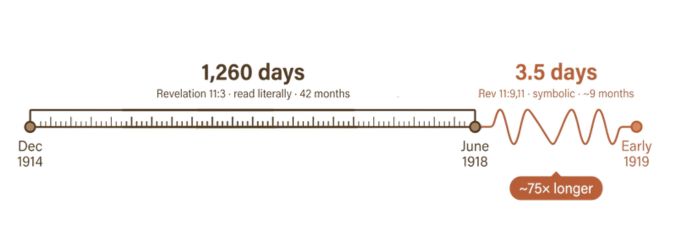
How the date is reached: 1,260 days read literally, then 3½ days read as roughly nine months.
Ezekiel 37
A vision is given to Ezekiel of a valley full of dry bones. They are then brought back to life as flesh is put back on them and God puts breath back into them. Until 2016, the organization taught that this prophecy applied to the Bible Students who were imprisoned in 1918 and then released in 1919. It was said that they became “just like that of the dry bones” then were revived in the spring of 1919.8 This scripture was paired with Revelation 11: the two witnesses who were dead for 3 ½ days. In 2016, the beginning of this captivity to “Babylon the Great” was pushed back to the second century C.E. In the new reading, Christianity fell into apostasy shortly after the apostles and was not revived until Charles Taze Russell and the Bible Students.9 The start of the captivity moved by about 1,700 years, but the end date stayed exactly at 1919. Everything before 1919 is negotiable; 1919 itself never moves.
Daniel 12
Daniel 12 is the closing chapter of Daniel’s final vision. An angel tells Daniel of a “time of distress,” the archangel Michael standing up for God’s people and the dead awakening. Then he answers the question “how long?” with three cryptic time periods: “a time, times, and half a time” (understood as 1,260 days), 1,290 days, and 1,335 days. Pay Attention to Daniel’s Prophecy! reads the 1,260 days as running from late 1914 to the leaders’ imprisonment in mid-1918, and the 1,290 days as beginning in early 1919, the year of their release and the organization’s revival.10 But this timeline was fitted to the history after the fact. Russell read the same numbers as years ending in 1874. Only in 1929 were they recast as literal days matching 1914-1926,11 and the 1918 hinge date has since shifted from April to June. The prophecy didn’t point to 1919; it was refitted around it.
What Christ Would Have Found
Now let’s examine what Jehovah’s Witnesses believe Christ found in his inspection and what they believe set them uniquely apart from Christendom. If the inspection was thorough enough to disqualify every religion on earth but theirs, then it’s fair to also examine what they taught at the time just as thoroughly.
To follow their reasoning, it helps to know that Witnesses judge faithfulness at the level of the organization, not the individual. Membership in the right organization, and good standing within it, is what separates a follower of Christ from someone in “Babylon the Great.” So when Jesus said his disciples would be known “by their fruits,” Witnesses apply that test to organizations.12
Witnesses point to several things that set them apart: they rejected “the hellfire lie,” the Trinity, and the immortal soul; they alone pointed to 1914; they refused to go to war; and their preaching work is unlike anyone else’s. They also acknowledge that at the time they still held some unclean practices, and that many of their early teachings have since been revised. A Witness will say those revisions were part of Christ’s refining, the separating of the wheat from the weeds, and will commonly point to Proverbs 4:18 about the path of the righteous one getting “brighter and brighter” as the reason for their organization’s doctrinal changes, rather than applying it to the gradual understanding of the individual.
Given this framework, let’s look at what they taught and practiced at the time to see what else Christ would have found during this “inspection period.”
| Then | Now | Sources | |
|---|---|---|---|
| Christ’s invisible presence began | 1874 | 1914 | Studies in the Scriptures, vol. 3, pp. 234-236 |
| Christ began reigning as King | 1878 | 1914 | Studies in the Scriptures, vol. 3, p. 234 |
| Fall of Jerusalem (basis for 1914) | 606 B.C.E. | 607 B.C.E. | Charles Taze Russell, Studies in the Scriptures, vol. 2, The Time Is at Hand (1889), pp. 79, 90 |
| “Time of the end” began | 1799 | 1914 | Studies in the Scriptures, vol. 3, p. 24 |
| Christ came to inspect his temple | Spring 1918 | 1914 to early 1919 | “Let God Be True” (1946), p. 192; The Watchtower, July 15, 2013, p. 11 |
| The “faithful and wise servant” of Matt 24:45 | Russell himself, still affirmed in 1920, a year after the supposed appointment | The Governing Body (since 2012-2013) | The Watch Tower, April 1, 1920, p. 100; Aug 15, 1925, p. 246; The Watchtower, July 15, 2013, p. 22 |
| Russell as a prophet | Antitype of the prophet Ezekiel | Not taught | The Watch Tower, February 15, 1919, pp. 53-54; The Finished Mystery (1917), pp. 377-381 |
| Dated predictions | Churches destroyed “wholesale” in 1918; republics gone and kingdoms “swallowed up in anarchy” in fall 1920; ancient worthies resurrected in 1925 | None fulfilled; none taught | The Finished Mystery (1918 ed.), pp. 485, 258; Millions Now Living Will Never Die (1920) pp. 88,89; Pay Attention to Daniel’s Prophecy! (1999), p. 304 |
| Neutrality in war | Watch Tower urged readers to keep May 30, 1918 as a day of prayer for the war’s outcome; some members served in the trenches | Strict neutrality; the 1918 prayer endorsement is now called a violation of neutrality | The Watch Tower, June 1, 1918, p. 83; Jehovah’s Witnesses: Proclaimers of God’s Kingdom (1993), p. 191; The Watchtower, June 15, 1987, “Testing and Sifting in Modern Times” |
| Censoring their own book | Pages 247-253 of The Finished Mystery cut out to satisfy censors | Acknowledged as a compromise | The Watchtower, 1955, p. 267; 1975 Yearbook of Jehovah’s Witnesses, p. 122 |
| Worship of Jesus | Jesus “was really worshipped, and properly so” | “No distinct worship is to be rendered to Jesus Christ” (1954) | Zion’s Watch Tower, July 15, 1898; The Watchtower, January 1, 1954, pp. 30-31 |
| Christmas | Celebrated; “quite immaterial upon what day” it is kept; Bethel celebrated until 1926 | Rejected as pagan | Zion’s Watch Tower, December 15, 1903, p. 165; God’s Kingdom Rules! (2014), ch. 10 |
| The cross | Cross-and-crown pin worn “as an identifying badge”; emblem on the Watch Tower cover from 1891 | Rejected as idolatrous; dropped by the early 1930s | God’s Kingdom Rules! (2014), ch. 10, pars. 12-13; 2015 Yearbook of Jehovah’s Witnesses, p. 174 |
| The Great Pyramid | Treated as a “witness in stone” confirming their chronology | Rejected in 1928 | Studies in the Scriptures, vol. 3, ch. 10, p. 313; The Watch Tower, December 1, 1928, “The Altar in Egypt” |
There’s a further problem, and it may be the most important one. If Christ appointed a new faithful and discreet slave in 1919, the men supposedly appointed didn’t know it. In April 1920, a year after the appointment supposedly took place, the Watch Tower asked its readers to affirm that the Lord “chose as an earthly representative to serve the household of faith one wise and faithful servant whom he made ruler over the household, and that the person so chosen was Charles Taze Russell.” It added that “no one in present truth for a moment doubts that Brother Russell filled the office”.13 This wasn’t a single stray remark. In 1923 the magazine criticized those who once accepted “Brother Russell as that servant” but later denied it,14 and in 1925 it stated plainly that “Brother Russell was that favored servant”.15 Only in 1927 did the Watch Tower say the servant did not refer “to any individual person” and apply it to the anointed collectively.16 The current teaching, that Christ appointed a small group of men in 1919 who now make up the Governing Body, was formally stated in 2013.17 The people who lived through 1919 believed the faithful servant had died in 1916. The appointment they are now said to have received is a reading of their history written nearly a century later.
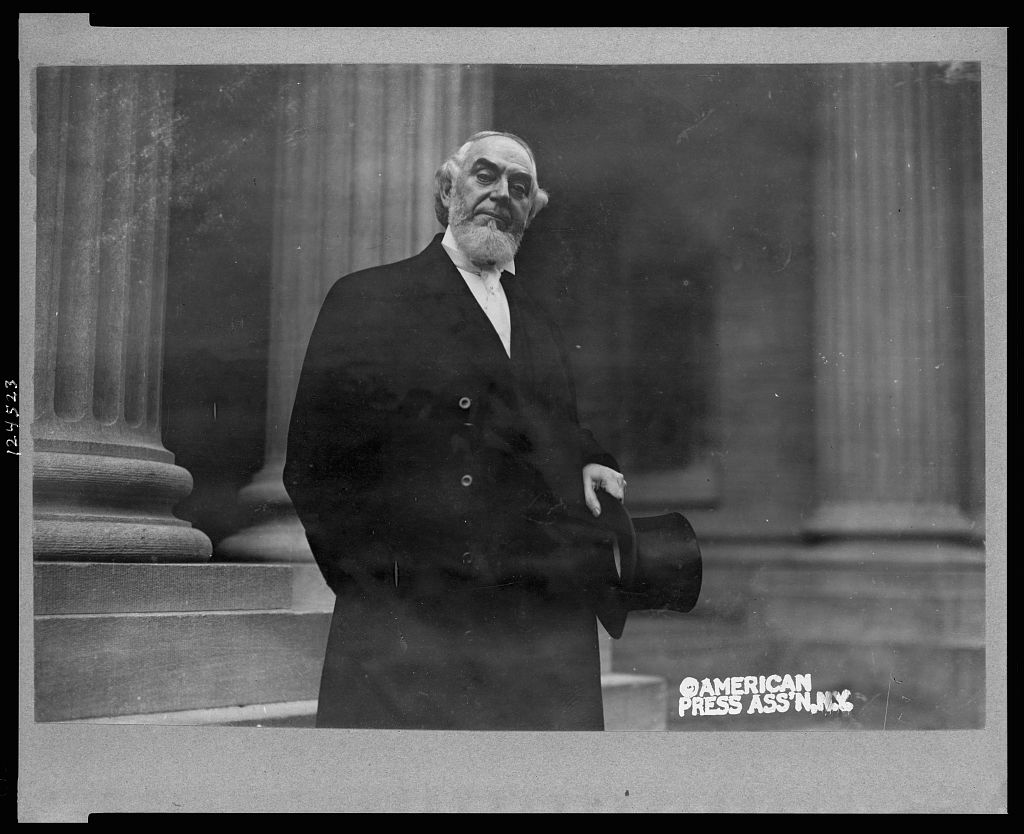
Charles Taze Russell. In 1920 the Watch Tower still taught that he was the “faithful and wise servant.”
The organization teaches the 1914-1919 inspection was sufficient to disqualify every other denomination. The same standard, applied to the Bible Students’ own record, raises a question the doctrine does not directly address: whether the criteria used to disqualify others would, if applied consistently, have disqualified this group as well.
The people who lived through 1919 believed the faithful servant had died in 1916.
A Test That Grades Itself
The Witnesses would point to the teachings they believe they did “get right” as evidence for the appointment, but here lies the problem of circular reasoning, which runs like this:
Jesus chose the Bible Students because they matched true Christianity.
How do we know what true Christianity looks like? Because they base teachings on the Bible, worship only Jehovah and make his name known, show genuine love, accept Jesus as Savior, stay no part of the world, and preach God’s kingdom.18
Why trust that list? Because it comes from the faithful and discreet slave, Christ’s appointed channel.
How do we know the slave is Christ’s appointed channel? Because Jesus chose them in 1919. (Back to step 1)
The candidate wrote the exam, graded it, and announced its own passing score. A fair test would set the marks of true Christianity from Scripture first, then score every group, including on the marks Witnesses would fail.
The candidate wrote the exam, graded it, and announced its own passing score.
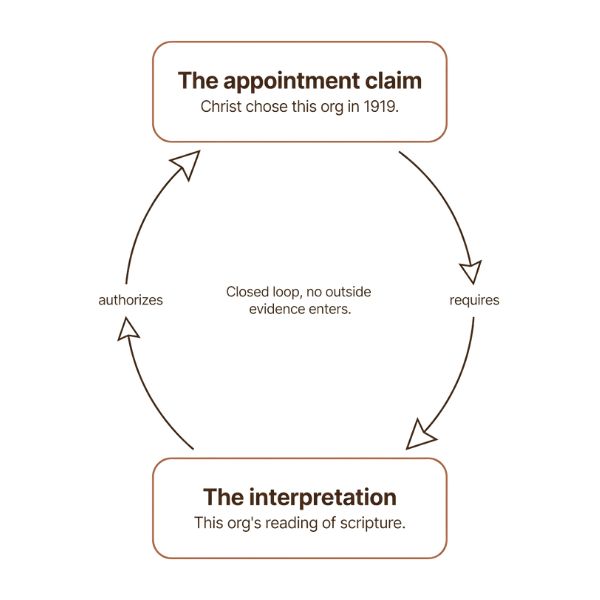
The appointment claim and the interpretation that supports it confirm only each other.
The Texts in Context
Let’s now look at each of the scriptures the Jehovah’s Witnesses use to support this appointment in context.
Matthew 24:45-47
This is the parable of the faithful and discreet slave that the Witnesses believe applies to the group of men who gives them “their food at the proper time,” or who they believe gives them doctrinal guidance from Jehovah. If you look at the same telling of the parable in Luke 12:42-44, though, Peter asks Jesus just before the parable, “Lord, are you telling this illustration just to us or also to everyone?” (Luke 12:41, NWT). Jesus doesn’t directly answer his question, but he goes on to say, “Everyone to whom much was given, much will be demanded of him” (Luke 12:48, NWT), which would seem to indicate that the application is for everyone to whom much has been given. In 2013 the Watchtower itself moved the master’s “arrival” in Matt 24:46 from 1918 to the future great tribulation.19 By their own reading, the master hasn’t arrived yet, so the slave hasn’t yet been found faithful. That undercuts using this parable as proof of a 1919 approval.
Malachi 3:1-4
The Bible Students applied this passage to Russell as the “messenger” who clears up the way and who precedes Christ’s refinement, but Jesus applies this passage to John the Baptist in Matthew 11:10, Mark 1:2 and Luke 7:27. The 2013 Watchtower agrees John the Baptist was the first fulfillment and argues for a “larger fulfillment”.20 However, there’s no indication in scripture that there would be another messenger to prepare a new way.
1 Peter 4:17
This is the passage of God’s “judgment” beginning with the “house of God.” To apply this passage to 1918, though, you have to ignore the fact that Peter is speaking of the present. In the previous verses Peter is speaking of suffering for one’s faith, and then he says, “For it is the appointed time for the judgment to start with the house of God” (NWT). Peter writes “it is” (present tense) to readers in the first century.
Revelation 11:3-12
Beyond the literal-then-symbolic switch covered above, verse 8 itself tells us to read the city where the witnesses lie symbolically. Fine. But then why read the 1,260 days in verse 3 literally? The passage gives no signal that one number is symbolic and the other literal.
Ezekiel 37:1-14
The vision explains itself: “these bones are the whole house of Israel” (v. 11, NWT), restored to their land and united under one king (vv. 12, 15-24). Nothing in it points to 1918 or 1919, and the organization’s own 2016 revision admitted its earlier 1918-1919 reading was wrong while keeping 1919 as the endpoint.
Daniel 12:7-12
Read in context, the three time periods belong to the grand climax of Daniel’s prophecy, when everything comes to a close. Verses 1-2 and 13 tie them to the resurrection and to “the end of the days” when Daniel himself rises. In September 2022 the Watchtower moved verses 2-3 to the future resurrection, but left verses 7-12 attached to 1914-1926. The chapter’s own frame is the end; the organization now agrees the opening verses are still future while keeping the middle pinned to its own history.
How Scripture Says to Test a Channel
Scripture itself tells us how to test a claim like this. Deuteronomy 18:21-22 gives the ultimate test of a claimed channel:
“However, you may say in your heart: ‘How will we know that Jehovah has not spoken the word?’ When the prophet speaks in the name of Jehovah and the word is not fulfilled or does not come true, then Jehovah did not speak that word. The prophet spoke it presumptuously. You should not fear him.” (NWT)
The test is simple: if what the claimed channel says will happen doesn’t come true, it is not God’s channel. Jehovah’s Witnesses will commonly respond to this by claiming that Russell was never considered a prophet or claimed to be one himself, but the writings of the time paint a different picture. “Careful Bible Students have no difficulty in recognizing the fact that the prophet Ezekiel types Pastor Russell.”21 The claim isn’t only about Russell. The test applies to whoever claims to be the channel, and the organization’s failed dates (the 1874 presence, the 1914 expectation of being taken to heaven, the fall of the churches in 1918, worldwide anarchy in 1920, the resurrection of the ancient worthies in 1925) were published by the Society itself.
And what about who the Bible says God’s channel is since Christ? 1 Timothy 2:5 states: “For there is one God, and one mediator between God and men, a man, Christ Jesus” (NWT).
That verse leaves no room for a human channel standing between God and the believer. The organization has answered it by narrowing it, teaching that Christ is the mediator only for the 144,000 anointed:
“Likewise, the Greater Moses, Jesus Christ, is not the Mediator between Jehovah God and all mankind. He is the Mediator between his heavenly Father, Jehovah God, and the nation of spiritual Israel, which is limited to only 144,000 members.”22
Follow that through. The same teaching holds that the great crowd of “other sheep” “is not in that new covenant” and receives its benefits only by associating with the anointed.23 If Christ is not their mediator, then their access to God runs through the anointed and the organization they lead, which is the very role 1 Timothy 2:5 reserves for Christ alone.
And what of the authority of the Governing Body? Jehovah’s Witnesses, when asked, will commonly say that they’re allowed to question things and “make the truth their own,” but in practice, Witnesses are told never to let curiosity lead them to critical material, and questioning the organization’s counsel is treated as a sign of pride. Their baptism study book says: “Those who are loyal to Jehovah have nothing to do with apostates. We would never allow curiosity or pressure from others to cause us to read or listen to apostate ideas.”24 And the organization has addressed the exact argument this essay makes:
“Yet there are some who point out that the organization has had to make adjustments before, and so they argue: ‘This shows that we have to make up our own mind on what to believe.’ This is independent thinking. Why is it so dangerous? Such thinking is an evidence of pride.”25
In other words, noticing the very changes documented above, and drawing your own conclusion from them, is itself treated as the problem.
In scripture though, the Bereans are praised for examining Paul and testing against scripture whether the things Paul was saying were true. Acts 17:10-11 (NWT): “Immediately by night the brothers sent both Paul and Silas to Be·roeʹa. On arriving, they went into the synagogue of the Jews. Now these were more noble-minded than those in Thes·sa·lo·niʹca, for they accepted the word with the greatest eagerness of mind, carefully examining the Scriptures daily to see whether these things were so.”
And scripture is explicit about the manner of Christ’s coming, which the Jehovah’s Witnesses claimed was invisible, private and datable. Matthew 24:23-27 (NWT): “Then if anyone says to you, ‘Look! Here is the Christ,’ or, ‘There!’ do not believe it. For false Christs and false prophets will arise and will perform great signs and wonders so as to mislead, if possible, even the chosen ones. Look! I have forewarned you. Therefore, if people say to you, ‘Look! He is in the wilderness,’ do not go out; ‘Look! He is in the inner rooms,’ do not believe it. For just as the lightning comes out of the east and shines over to the west, so the presence of the Son of man will be.” Claiming that Christ “invisibly” came is essentially saying that “he is in the inner rooms,” or that he secretly came. Jesus is saying not to believe this person. The NWT renders parousia as “presence,” and Witnesses argue a presence can be invisible and recognized by a sign. However, in verse 27 the lightning image is about visibility from east to west, not secrecy. Revelation 1:7 says that “every eye will see him,” and Acts 1:11 says that he “will come in the same way as you have seen him going into the sky” (NWT), visibly. Likewise in Matthew 24:36 Jesus warns, “Concerning that day and hour nobody knows” (NWT). This is in contrast to the constant date setting of the early Bible Students.
Finally, the Watchtower itself describes its message as different. In a 1980 article, it answers critics who point out that Christendom’s missionaries reached the world long before Jehovah’s Witnesses did. Its reply is that the Witnesses’ Kingdom preaching since 1914 “has been something far different from what Christendom’s missionaries have published.” A Witness might say that’s to be expected, since they believe Christendom is apostate. But the article goes further. It explains that the difference is that their preaching “has not been a witness concerning the kingdom mentioned in Colossians 1:13,” the kingdom Paul told the Colossians they had already been transferred into (Colossians 1:13). Instead, the article defines its good news as the Kingdom “having been established in the heavens in 1914.” A summary box then gives six reasons the message is different. Every one centers on 1914, 1919, the last days, or survival into the new world. None mentions Christ’s death for our sins or his resurrection.26
To be fair, Witnesses do teach a version of the ransom. But by the article’s own account, what sets their message apart, the thing it calls “unique,” is a date no apostle could have preached. Paul described the good news he delivered “among the first things”: that Christ died for our sins, was buried, and was raised up on the third day (1 Corinthians 15:1-4, NWT). And he warned that “even if we or an angel out of heaven were to declare to you as good news something beyond the good news we declared to you, let him be accursed” (Galatians 1:8, NWT). The question for the reader is simple: is the message preached at the door and the cart the one Paul delivered, or the one announced in 1914?
Conclusion
Let’s return to the stakes at hand. If Christ did choose the Governing Body as the faithful and discreet slave, his sole channel of communication, in 1919, then rejecting this channel would ultimately be rejecting God. If this is a false claim, then it is a Christian’s obligation to expose it (Ephesians 5:11). I leave it to the reader to decide if the claims are true or not by examining the historical record, verifying the citations on wol.jw.org, and examining them against scripture. I’ll close with a scripture that almost all Bible readers know and that I hope everyone understands: “Jesus said to him: ‘I am the way and the truth and the life. No one comes to the Father except through me.’” (John 14:6, NWT) Jesus shows the way to the Father, and I hope you take it.
Frequently Asked Questions About the Faithful and Discreet Slave
What is the faithful and discreet slave?
The phrase comes from Jesus’ illustration in Matthew 24:45-47, about a slave “whom his master appointed over his domestics, to give them their food at the proper time” (NWT). Luke 12:41-48 records a parallel version, introduced by Peter asking whether the illustration was meant “just to us or also to everyone.”
Who do Jehovah’s Witnesses say the faithful and discreet slave is?
Since 2012-2013, Jehovah’s Witnesses have taught that the faithful and discreet slave is “a small group of anointed brothers” who make up the Governing Body.27 Earlier, the Watch Tower identified the slave as Charles Taze Russell personally, and from 1927 as the anointed as a whole.
When do Jehovah’s Witnesses say the faithful and discreet slave was appointed?
They teach that Jesus inspected professed Christians from 1914 to “the early part of 1919” and appointed the faithful and discreet slave over his domestics in 1919.28 A second appointment, “over all his belongings,” is now taught to be still future.
Who did the Bible Students say was the faithful and discreet slave in 1919?
Charles Taze Russell. As late as April 1920, the Watch Tower asked readers to affirm that “the person so chosen was Charles Taze Russell”.29
Is the Governing Body the faithful and discreet slave?
That is the organization’s claim, but the text doesn’t name a group or a date. In Luke’s account Jesus answers Peter’s question with a principle for every steward: “Everyone to whom much was given, much will be demanded of him” (Luke 12:48, NWT). And since 2013 the organization itself places the master’s arrival in the future, so by its own reading the slave has not yet been found faithful.
Does the Bible say when the faithful and discreet slave would be appointed?
No. No verse names 1914 or 1919. The date comes from combining Malachi 3, Revelation 11, Ezekiel 37, and Daniel 12, each of which the organization has reinterpreted while keeping 1919 as the endpoint.
Can the Governing Body make mistakes?
Yes, by its own admission: “The Governing Body is neither inspired nor infallible. Therefore, it can err in doctrinal matters or in organizational direction”.30
How can I check these claims for myself?
Every citation in this article links to its source on wol.jw.org, jw.org, or the Internet Archive. Like the Bereans in Acts 17:11, you can read each passage and publication and test the claim against Scripture yourself.